
Psychology and counselling website design
Website design for psychologists and counsellors Adelaide
Help people feel comfortable taking the next step
Website Adelaide designs websites for psychologists, counsellors and therapists across Adelaide and South Australia, helping people understand the practitioner, the support available and what making contact involves.

147 5-star Google reviews from our clients

Adelaide’s Top 3 Web Designers, 8 Years Running

Website Adelaide
Adelaide . South Australia
Your website should build confidence before the first conversation.
Website design for psychology and counselling practices
Website Adelaide is an Adelaide website designer for psychologists, counsellors and therapists, from sole practitioners through to multi-practitioner practices and professional organisations.
Our experience includes websites for:
01
psychologists
02
counsellors and therapists
03
youth and family practitioners
04
coaching psychologists
05
multi-practitioner therapy clinics
06
counselling and recovery coaching services
07
psychoanalytic and psychotherapy services
08
professional and training bodies
People are often choosing the practitioner as much as the service.
That makes professional scope, client groups, therapeutic approach and the way appointments work particularly important when we plan the website.
A sole practitioner may need a focused structure around their professional background, core services and appointment pathway. A larger practice may need clearer distinctions between practitioners, client groups, locations or types of support.
Our website strategy process starts by understanding the practitioner’s professional scope, client groups, approach and appointment pathway before the pages and content are planned.


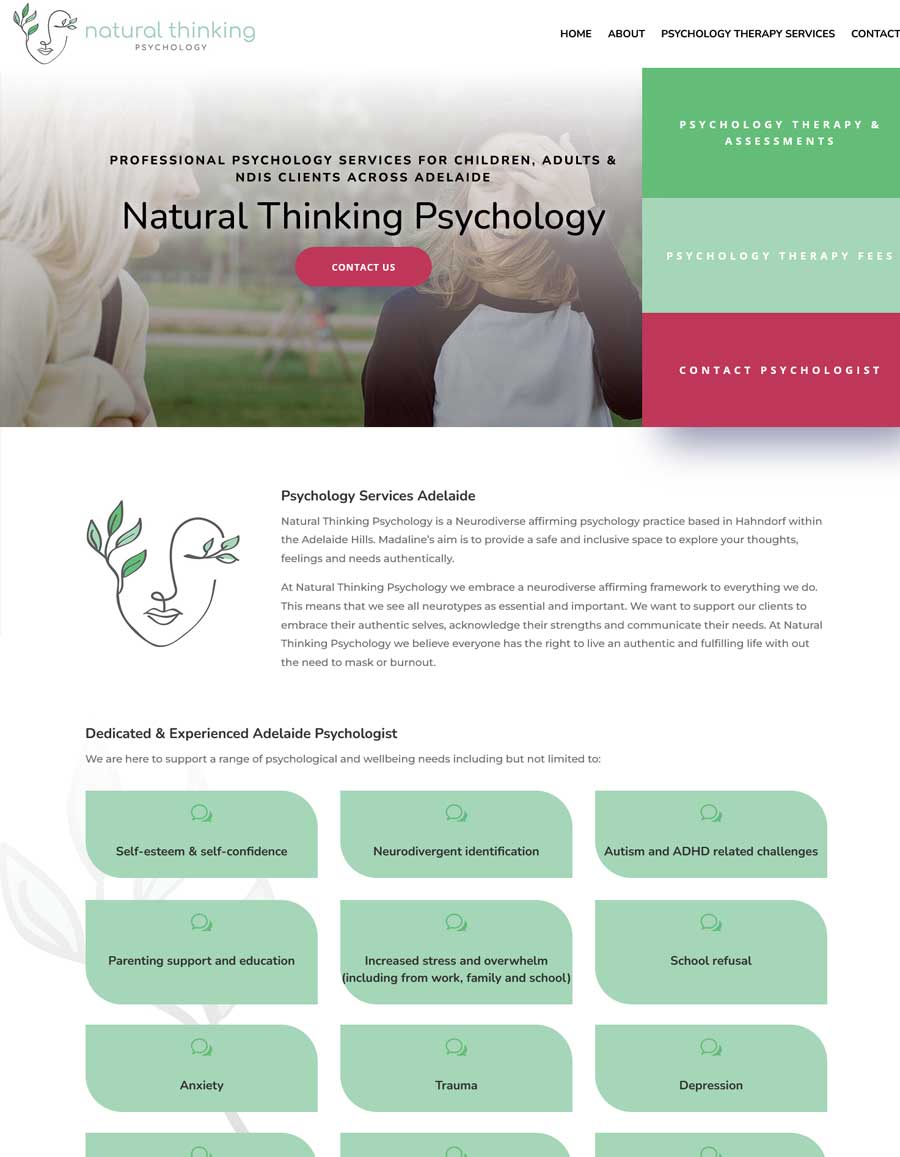
People are often deciding if they are ready
Someone visiting a psychology or counselling website may still be deciding whether they want to contact anyone at all.
They may be researching privately and comparing several practitioners before deciding who feels credible, approachable and relevant to what they are experiencing.
Our approach would be to answer the questions that can reduce that uncertainty without relying on generic reassurance.
People may want to know:
- does this practitioner work with people like me
- do they support the issue I am experiencing
- what are their qualifications and professional registrations
- what happens in the first session
- how much appointments cost
- whether Medicare or other rebates may apply
- how privacy and confidentiality work
- whether sessions are in person or online
- how to make first contact
- what to do if the service is not suitable
From our experience, addressing those uncertainties directly can be more helpful than simply telling someone that the practice is welcoming or supportive.
Make practitioner fit easier to understand
In this sector, the practitioner profile can be one of the most important pages on the website.
A useful profile may explain:
01
qualifications
02
professional registration or membership
03
areas of practice
04
modalities or therapeutic approaches
05
client groups
06
professional background
07
how the practitioner works
08
locations and appointment formats
The level of detail depends on the individual practitioner.
We have found that a personal description can help someone understand the person behind the professional role, but it should still support the decision rather than becoming an extended personal biography.
The strongest profiles help the reader answer a practical question: does this practitioner seem relevant to what I need?

Psychology and counselling are not interchangeable
Psychologists, counsellors and therapists may appear within the same broad sector, but the website should not present the professional titles as if they mean the same thing.
Registration, professional scope, Medicare arrangements and advertising requirements can differ.
A psychologist may need to explain AHPRA registration, psychological services and Medicare rebate arrangements where relevant. A counsellor may need greater clarity around professional membership, areas of practice and the fact that services may not attract Medicare rebates.
We have worked on websites where these distinctions materially changed the content structure.
For example, psychological counselling and coaching psychology may need to be separated because the services and Medicare arrangements can be different.
Our role is to make those differences understandable without adding unnecessary clinical or professional jargon.
Explain what the first session involves
The first appointment can feel like a large step when someone has not previously seen a psychologist, counsellor or therapist.
We often recommend explaining:
- what happens before the appointment
- what may be discussed in the first session
- how long the session lasts
- what the client needs to bring
- how confidentiality works
- what happens after the first session
- whether ongoing appointments are discussed
- how telehealth works where offered
The content should set expectations without promising a particular outcome.
When we worked on a youth and adult counselling website, the site needed to speak to both young people and parents while explaining consent, privacy and when parent involvement may occur.
Separate services and client groups where needed
A practice may offer several services or work with several client groups.
These do not always belong on one general page.
A psychologist may work with adults and also provide coaching psychology. A counselling practice may offer individual counselling, group therapy and recovery coaching. A larger clinic may work across different life stages or several practitioner specialties.
We look at where the decision genuinely changes.
If the audience, appointment pathway, practitioner, fees or type of support are different, separate pages may make the website easier to understand.
If the services are closely related and need very little separate explanation, keeping them together may be more useful.
The objective is not to create the largest possible website. It is to give each important service or audience enough clarity.
Fees and rebates should be easy to find
Uncertainty around cost can add another barrier before someone reaches out.
Where possible, we recommend making fees easy to locate.
For psychology practices, that may include session fees, Medicare rebate information and referral requirements.
Counselling and therapy practices may need to explain their fee structure and make it clear where Medicare rebates do not apply.
The practice needs to confirm its current fees and provider arrangements, but we can organise that information so it is easier for prospective clients to understand.
This practical information supports trust just as much as qualifications and practitioner profiles.
Privacy deserves clear explanation
People considering psychological or counselling support may be particularly sensitive to privacy.
The website does not need to become a legal document, but it should explain relevant confidentiality and privacy arrangements clearly enough for the client to understand what to expect.
For youth services, parent involvement and consent may require more specific information. For telehealth, it may also be useful to explain how online appointments work and what the client needs to participate privately.
Where the practice is not an emergency or crisis service, that limitation should also be stated clearly.
Urgent-support information can be included on the contact page, booking page or footer without overwhelming the main service content.
The contact pathway should feel straightforward
Not every practice wants the same booking process.
Some use direct online booking. Others prefer an enquiry first, particularly where practitioner suitability or service fit needs to be discussed.
We have worked with practices using:
- online appointment booking
- contact forms
- introductory phone calls
- discovery sessions
- practitioner selection
- multiple clinic locations
- telehealth appointments
The website should explain what happens after someone takes the first step.
A vague “Get in touch” button can create unnecessary uncertainty if the person does not know whether they are booking an appointment, requesting a callback or simply asking a question.
We prefer to make the next step clear before someone clicks.
Local and telehealth pathways can work together
Many psychology and counselling practices remain strongly location-based, while telehealth has widened the potential audience.
A local Adelaide practice may need clear information around clinic location, parking and appointment availability.
Another practitioner may work with clients across South Australia or more broadly through telehealth.
Where both are offered, we usually create clear pathways so visitors understand which appointment formats are available and where.
Search visibility should reflect the practice’s genuine reach rather than creating location pages for areas where the practitioner does not actually work.
New and established practices need different websites
01
A new private practice may be led by an experienced practitioner but have little history under the new business name.
A well-planned website design can establish credibility through qualifications, professional background, registration, areas of practice and a clear explanation of how appointments work.
It should not imply that the new practice has a client history or outcomes it cannot substantiate.
02
Established practices often face another problem.
Services may have expanded, practitioner profiles may be inconsistent and fees, locations or appointment information may have become outdated.
Our website redesign service can retain useful content and existing search value while reorganising the website around current practitioners, services, locations and client pathways.
Build content around the practice you actually provide
We have found that psychology and counselling websites can become repetitive when they try to create pages for every possible concern or search phrase.
A better approach is usually to start with the services, client groups and areas of practice that genuinely matter to the practitioner.
From there, deeper content can be added where there is a clear need.
That might include individual service pages, specific client groups, telehealth, practitioner profiles or carefully selected concerns.
Our website copywriting and on-page SEO are planned together so search visibility supports appropriate enquiries rather than attracting traffic outside the practitioner’s professional scope.
Our psychology and counselling website experience
We have worked with psychologists, counsellors, therapy practices and professional organisations across Adelaide and South Australia.
For detailed examples, visit our Psychologist, Counsellor and Therapist Website Design industry page.
Those projects have included sole practitioners, youth counselling, multi-practitioner clinics, counselling and recovery coaching, coaching psychology and professional psychoanalytic organisations.
Across them, one point has remained consistent: people need enough professional information to feel confident, but also enough human context to feel comfortable making contact.


Frequently asked questions about website design in Adelaide for psychologists, counsellors and therapists
Do psychologists and counsellors need different website content?
Often, yes. Registration, professional scope, Medicare arrangements and advertising requirements differ, so the website should describe each practitioner and service accurately.
Can you write content for a youth counselling practice?
Yes. Youth-focused websites may need to speak to both young people and parents while explaining privacy, consent and parent involvement carefully.
Can the website include online appointment booking?
Yes. Existing booking or practice-management platforms can often be linked or integrated, depending on the system and the preferred first-contact process.
Can you explain fees and Medicare rebates?
Yes. We can organise fees, referral requirements and rebate information clearly. The practice needs to confirm its current fees and provider arrangements.
Can you redesign an established therapy website?
Yes. We can retain useful content and existing search value while improving practitioner profiles, services, fees, locations and contact pathways.
Discuss your practice website
A strong psychology or counselling website should help people understand who you work with, how you work and what happens when they take the first step.
We can help organise your professional information, services, practitioner profiles, fees and appointment pathways into a website that feels clear, appropriate and easy to use.
Explore how we work, review our website design pricing, or contact Website Adelaide to discuss a new practice website or redesign.